Showing posts with label Fizz Boom Read. Show all posts

Friday, August 15, 2014

Fizz Boom Read!: Summer Reading Finale Party

Like many libraries, we end our children's summer reading program with a party. Everybody does this a little differently, and I figured it might be worthwhile to some if I shared how it works here.


Here's how it goes:
  • The official spiel is that only kids that complete their reading logs get to attend the party. This is done to create an incentive to finish and hype up the party. In reality, I am pretty flexible. I will let a whole family in with one invite. If kids show up that haven't finished, all they need to do is sign a little "contract" saying they will read as much as possible.
  • Registration is required, but again very flexible. If you show up the day of and have not registered, that is not a problem at all. Registration is mainly a tool so I have a rough idea how many kids to expect.
  • The party usually consists of about 6 different stations relating to the summer theme. These stations are supervised by volunteers from our Friends, as well as teen volunteers. The kids can go through these stations are their own pace.

Our stations this year:

Making bouncy balls: We used a recipe I found to make bouncy balls. It involves mixing glue, a borax solution and cornstarch. I wouldn't say all of them turned out great, but the kids had fun. It was one of the messiest stations and kept as close to the sink as possible. I also made sure to provide baggies so the kids could take them home.


Lego table: I set out our collection of Legos for the kids to build with. Always a hit, and a fun, non-messy activity.


Making oobleck: The classic creation of a "non-Newtonian fluid" with cornstarch and water. It acts like both a solid and a liquid. Even though it was close to the sink, we still ended up with a trail of cornstarch on the carpet. Thank goodness for vaccuums!


Bubble station: This was actually the most time intensive station to plan. I had the last minute idea to fill a kiddie pool with homemade bubble solution, but wasn't sure how I was going to pull it off. There were so many possible recipes online and several mentioned letting bubbles sit for at least overnight, which wasn't an option. I ended up following this recipe and creating about a gallon of solution the day before. It seemed to work well enough to make giant bubbles with the wand I had (even without sitting overnight) so I figured it would suit the purpose.

1 gallon of water
1 cup Dawn Dishsoap
4 tablespoons of glycerin (bought near the cake decorating supplies at Michaels)

The day of the party I followed roughly the same ratios to fill a small kiddie pool I got on clearance at Toys R Us. It only took about 3 gallons, and worked out really well. The kids made bubbles with hula hoops and various bubble wands found at the dollar store. I also had a few giant bubble wands bought on clearance at Michaels. The kids had a great time at this station. One volunteer even commented that it was the hit of the party!

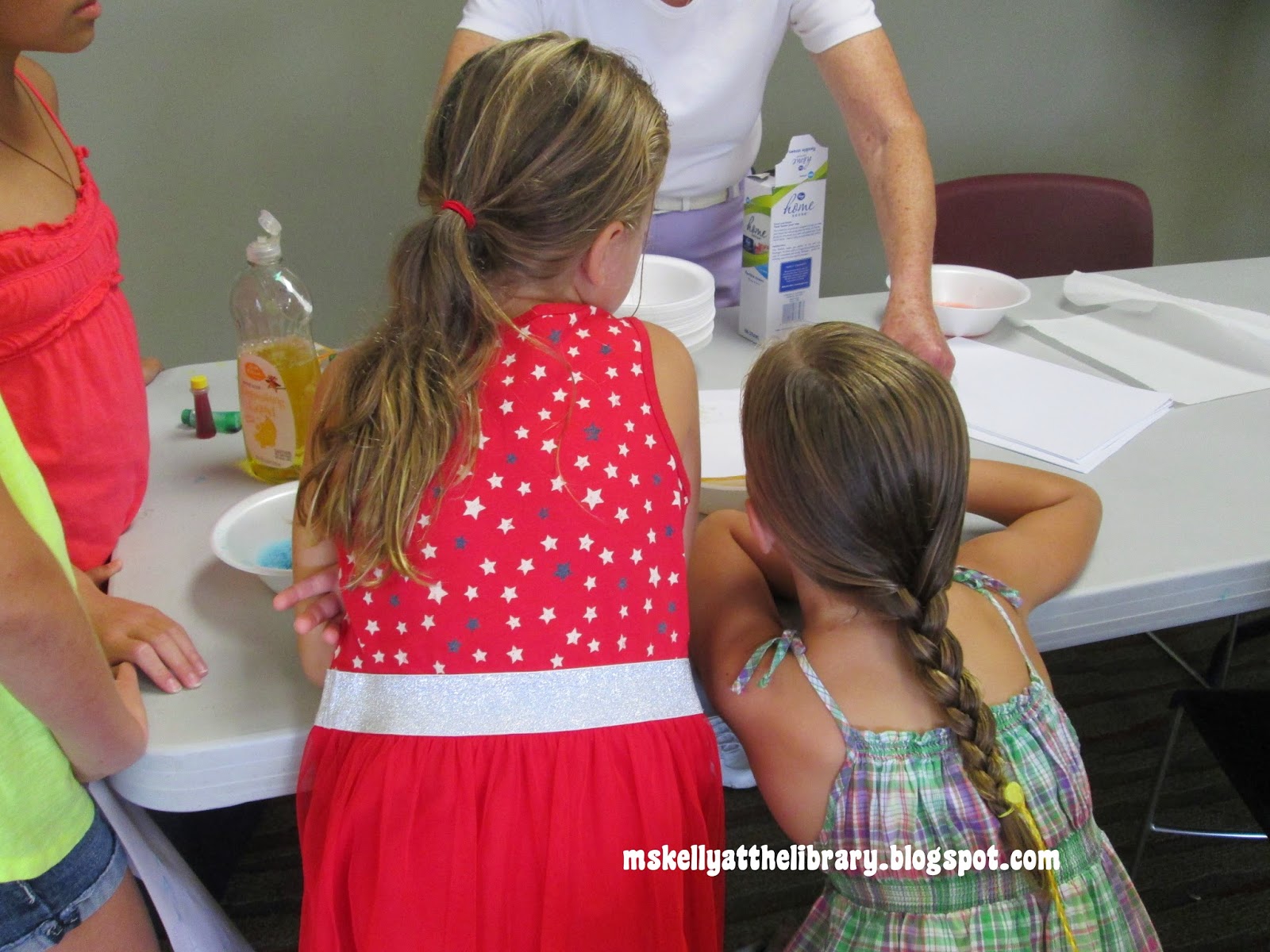
Crafts: I had several crafts for the kids to do. The first was decorating "science journals" made out of construction paper and computer paper. I also had food coloring, dish soap and water out so they could "paint" with bubbles. The final craft was making rotocopters. The only snag in this station is that apparently the bubble painting came out pretty light. I'll definitely have to rethink how to do it in the future.


Snacks: A must have for any party. I couldn't think of any science themed snacks, so I bought cookies, chips and juice for the kids to enjoy.

All in all, I think our party went very well. We had about 70 people there, which is a pretty big crowd for us. I'm already looking forward to next year!

Thursday, August 14, 2014

Fizz, Boom, Read!: Catapult Science

Next on my list of SRP programs to catch readers up on is the Catapult Science program I did for Grades 3-6. I originally got the idea for this program from Lisa Mulvenna of Lisa's Libraryland. I knew it would be a fun and easy program to do for this summer's theme and definitely wanted to give it a try.


For the first half of the program I followed Lisa's plan, with a few minor changes. I set out popsicle sticks, plastic spoons, rubber bands, and Lisa's handout and talked to the kids about what a catapult is and how they were used. They especially loved the gross tidbit that sometimes catapults were used to launch diseased corpses.

After that, I guided the kids in building their catapults. Most of them did pretty well, although a few did need some extra help. Here's what the finished product looked like:


After building the catapults the kids got the chance to fire them. Here's where the few minor changes come in. I provided printed out targets for the kids to tape on the wall with scotch tape. After reading that Lisa's director wasn't a fan of masking tape on the wall I didn't want to risk it with mine!

I also provided paper and markers for the kids to design their own targets. I figured this could add a little artistic element into this STEAM program. The kids came up with some great stuff!

Sorry Beliebers!


Some even created mock castle walls after hearing how catapults used to be used in warfare.


The second half of this program I changed course and had the kids make a different kind of projectile device: a marshmallow shooter. I've had the kids make these before at a Marshmallow Madness program I did. They are super simple. They consist of a cup with the bottom cut out, which is covered with the tied end of a balloon. You place the marshmallow in the cup, pull the balloon back and launch it.

I wanted to include the Marshmallow shooters so that the kids would have the chance to try more than one device and compare. I was glad I did because they made some great comparisons. One boy said that in both devices the farther you pull back the farther you can launch something. Others compared how the marshmallows launched to how the pompoms launched.

This was a fun program and a great way to end our school age programming for the summer. Thanks so much for sharing Lisa!

Wednesday, August 13, 2014

Science Storytimes Week #5: Fizz, Boom, Pop!

Between the end of our summer reading program and major computer issues at my library, I've gotten behind on my blogging. First on my list to catch you all up on is my last science based storytime. So far we have learned about movement, water, growth, and construction. The title of our last session was "Fizz, Boom, Pop" and the subject was bubbles and balloons. I figured this would be a good theme because I know how fascinated kids are with both these things. Just like this cat is.


Another reason I chose this theme is I had two great books I wanted to read to the kids. One is "Perfectly Percy" by Paul Schmid. It is hands down one of the most adorable pictures books I have ever read. Percy is a porcupine who loves balloons. Balloons clearly don't love Percy, so he has an an obvious problem to solve.

The second book I choose was a new one, "Big Bad Bubble" by Adam Rubin. The premise is that a group of monsters is terrified of  bubbles. The preschoolers really seemed to enjoy this story, and participated well in all the interactive aspects.

I followed these stories with songs and parachute time. As usual, an exact plan of songs and rhymes is available on my storytime blog.

Our stations included:

Painting with balloons: I filled balloons with rice and had the kids paint with them. This was meant to combine fine motor skill development with a fun sensory experience. It was definitely a hit with both the preschoolers and the toddlers.


Sink and float balloons: At this station I had water balloons and air balloons for the kids to place in water. It was surprisingly even more messy than the paint was. Another surprise was that a few of the kids didn't seem very interested in this one. Maybe this was because of all the other bubbles and balloons around?


Exploring Bubbles: I had a few different types of bubble wands out for the kids to blow bubbles with. These were all purchased on sale and reused at the bubble station of our Summer Reading Finale Party.


Balloon Toss: I set out some balloons for the kids to throw back and forth. I explained to parents that doing some imparted knowledge about gravity and forces. The kids had a great time doing this, even the little one who decided popping the balloons was much more fun. I didn't get any good pictures at this station, mainly because the kids were moving around so much.

I was definitely happy with how this and my other science storytimes went. I got a lot of positive feedback from parents, and attendance did rise somewhat compared to last summer.

I would love to use this format more in the fall and would appreciate any suggestions from those who have done anything similar!

Friday, August 1, 2014

Fizz, Boom, Read!: Candy Science

This week's program for grades 3-6 was Candy Science. I can't lie; planning this program made me feel a little bit like Willy Wonka.


My goal for this program was to increase the kids' understanding of science concepts through experiments involving candy. The kids were understandably excited about this.


Here's what we did:

Removing M's from M&Ms: I found this idea here. It is super simple but very impressive. The kids put a handful of M&Ms in a bowl of water and waited for the M's to float up as the coating dissolved. I made sure they did this experiment first because when I tried it at home it took awhile for them to float up on their own (maybe a half hour?). I was grateful it happened a little more quickly for the kids.


Sink or float candy: We tested different fun sized candy bars to see if they sank or floated. I found this idea on Reading Confetti. We used Kit Kats, Milky Ways, Snickers and Three Musketeers. Spoiler Alert: The Kit Kats and Three Musketeers floated, while the Snickers and Milky Way sank. The kids definitely seemed to understand that the candy's fillings were what made the difference. We even had a short discussion about density. Unfortunately, I didn't get a picture of this one.

Dissolving Gobstoppers: Another experiment to learn about dissolving. If you place Gobstoppers in water evenly spaced they will disolve and the colors will remain distinct. Next time I do this program I would love to try testing the same experiment with other liquids, as Steve Spangler suggests.


Gumdrop Engineering: I gave the kids a set number of gumdrops and toothpicks and told them to build as tall of a tower as they could in ten minutes. First we did it individually, then I had them repeat the challenge in teams. This was an activity I've done before with marshmallows, and it always seems to be a hit. We discussed their scientific thinking afterwards. For instance, we talked about which shapes seem to be the most stable.

One of the individual creations.


One of the creations from our team challenge.
How it went:
Overall, I think the kids had a good time. They seemed impressed by the M&M and Gobstopper experiments and did a great job making the gum drop towers. I'm sure they would love to do something like this again.


Tips and Tricks:
  • Try to hand out the candy on an "as needed" basis as much as possible. This will help keep the kids eating too much. I did send the kids home with a few fun sized bars each, and let them snack on the gobstoppers and M&Ms throughout the program.
  • For the M&M experiment, the more candy you put in to dissolve, the grosser the result will be. It will also make it just a little harder to see the M's as they rise. I did remind the kids of this and suggested they put around 5 pieces in for best results. I combined that with the statement: "Why waste perfectly good candy we could be eating?"
  • Styrofoam bowls are just a little too slippery for the Gobstopper experiment. The gobstoppers kept slipping to the center of the bowl, instead of sitting along the edges as they did when I tried it at home.
  • Candy chromotography would be a great addition to this program. The only reason I didn't do it this time is that we did it earlier this summer at a science themed crafts program.
This post is part of Thrive Thursday, a blog hop in which librarians share school age program ideas. This month's roundup is hosted by Amy at The Show Me Librarian. Head over and check it out for more great ideas!

Wednesday, July 30, 2014

Science Storytimes Week #4: Fizz, Boom, Construct!

We've been busy little scientists this summer! During the past three weeks the preschoolers and toddlers at my library have learned about movement, water, and growth. Our topic this week is a perennial storytime favorite: Construction!

Create your own construction sign here.

For a listing of songs and book used in the first half of this storytime see my storytime blog.

Our centers included:

Building with Legos: I love to incorporate Legos into my programs whenever possible because they are just so darn awesome.They keep kids occupied like nothing else I have ever seen. For this age group I have a small collection of Duplos we received awhile back through the "Read Build Play" program. I put these out our our table for the kids to explore and provided instruction about the benefits of playing with Legos.


Constructing with boxes: We all know how much kids love boxes right? I've honestly done a whole hour long program just letting kids decorate and play with boxes. For the preschoolers and toddlers I saved a stack of boxes and challenged them to see how high they could stack them. When their tower of boxes falls they got to learn a valuable lesson about forces!


Vehicle matching: I set out pairs of construction vehicle pictures and asked the kids to match the pairs. This is practice with the scientific skills of observation. When they identify each vehicle they are using another scientific practice: classification. Unfortunately this center got overshadowed by the boxes and Legos and was passed over by many kids.


Decorate a truck:  To add the A in STEAM the kids used bingo daubers to decorate construction vehicle pictures. Bingo dauber crafts are one of my favorites and I try to use them for our crafts at least once each during each series of storytimes.


How it went:
Compared to last week the kids were a little quieter and shyer during the stories and songs. I broke out the parachute with the preschool group to get the kids a bit more excited. They seemed to love the centers, especially the Legos and boxes. One little girl in particular was having so much fun she got upset when it was time to leave :)

I'd love to hear any questions, feedback or ideas you have to contribute! Thanks for reading :)

Thursday, July 24, 2014

Science Storytimes Week #3: Fizz, Boom, Grow!

So far at our science themed storytimes for toddlers and preschoolers we have learned about movement and water. The theme of this week's science storytime was growing.  I was definitely inspired by Abby's the Librarian's preschool lab on the same topic! We learned about living things and how, like this baby panda, they all grow and change.


For the preschoolers this week I chose "Do you know which ones will grow?" by Susan Shea. I love how this book provides many examples of living and non living things and asks children to participate in deciding which will grow.

After our story we did a variety of songs and crafts related to living and nonliving things. I even created a new flannel board to use. For a listing of the exact songs and activities please head over to my storytime blog.

Our centers this week included:

Painting with plants: I've been trying to include at least one craft related to our theme each week. For this theme I thought "What could be more fun than painting with vegetables?" I bought a variety of vegetables that might make neat impressions when dipped in paint, cut them up and let the kids have fun.


Living or Non-Living: I had my wonderful volunteers and pages cut out pictures of various objects for the kids to sort and glue onto a worksheet.


Plant a Flower Bulb: I bought a small bag of potting soil, pots and flower bulbs for the kids to plant. I saw this in Abby's preschool lab post and figured this would be a fun and messy way for the kids to learn about how a plant grows. Plus, the supplies were all on sale this time of year, so it worked out perfectly.


Baby Animal Matchup: To focus specifically on animals, I had the kids matchup pictures of animal parents and babies.


Measure yourself: I hung up a few of the "measure yourself" handouts that have been hanging around the library for quite awhile. I encouraged parents and kids to measure themselves, because people are growing things too! I also included a sheet for the kids to record their measurements and make a handprint.


This storytime went very well. Both groups had a good turn out and seemed to have lots of fun. More than one parent has told me how much their child is enjoying the storytimes this summer, which of course makes it all worthwhile.

Would love to hear any feedback you have or ideas for additional science based storytimes! In addition to the comments section you can reach me on Twitter and Pinterest.

Wednesday, July 16, 2014

Science Storytimes Week #2: Fizz, Boom, Splash!

In case you missed last week's post, I am doing science storytimes this summer. These storytimes will consist my typical storytime activities followed by science based centers. This week's theme is water.


As usual, we started out in our storytime room. We enjoyed a book together and did music and movement activities related to rain and oceans. For a list of these activities see my storytime blog.

After about 25 minutes of songs and books we went into one of our meeting rooms to enjoy our science centers. We have been doing our centers in there many because of space issues. I love my storytime room but it is a little small to run centers.

The ideas for these centers came from Amy Koester and Katie Salo.

Our centers were:

A sink or float station: This was one I found in both Amy's and Katie's posts on preschool water science. The basic idea is a variety of objects were put out and the kids got to test if they sank or floated. Some of the objects I put out included sponges, pennies, rocks, and pieces of a pool noodle.


Porosity station: The idea of this center came from Amy's post. The purpose is for kids to explore how water interacts with a variety of objects. I included sponges, dish scrubbing rings, cups with and without holes and a piece of pool noodle.


Mirror reflection station: At this station kids got a chance to see how water influences reflection. I set out of plastic bins of water with mirrors placed inside. I also provided cups for pouring water on the mirrors. The kids were able see how their reflection changed with the disturbance of the water. I got the idea for this station from this post.


Coffee Filter Art: The kids colored on coffee filters which were then sprayed with water to spread and blend the color. This is a project I've read about many different places and have done with older kids in the past. I figured that it would fit perfectly as our water themed craft.


All in all I think this storytime went very well. Both storytime groups enjoyed the centers and I think they learned a little too.

The centers also seemed to do a good job of promoting parent/child interaction. I heard many parents asking their children questions at each center.

Next week's science storytime theme is "Fizz, Boom, Grow". Let me know if you have any suggestions for science activities for that theme or any other!

Thursday, July 10, 2014

Fizz, Boom, Read!: The Science of Force

Our second program for Grades 3-6 for the summer was all about forces. There are a lot of cool activities out there related to forces, and I figured that the kids would not be able to resist the fun of balloon rockets and paper airplanes.

I, on the other hand, cannot resist the fun of a Star Wars gif:

Definitely heard this a few times during this program.

After a quick discussion on what a force is we started out by learning about the idea of thrust with balloon rockets. The idea behind these is super simple. The first thing you do is tie a string to a support. Next you blow up a balloon and tape a straw on it. The string goes through the straw. When you let the air out of the balloon it shoots up the string.

I also added an element of friction to this activity by using both yarn and fishing line instead of string. The idea was that the balloons would travel more quickly up the fishing line than the yarn, and this seemed to be the case for most that tried it.

The kids enjoyed doing this, but it was a little more time intensive then I anticipated.

For the majority of the second half of the program we learned about gravity and wind resistance with paper airplanes. I had set out supplies such as construction paper, regular paper and paper airplane directions. During the program I allowed the kids time to create their airplanes and test them for distance/accuracy.

Here are some kids hard at work practicing their accuracy.:


Our last activity was Freeze Tag. This ties into forces because an "An object in motion must stay in motion, and an object at rest must stay at rest, unless acted upon by a force." The tagging was the force that caused the players to rest or move. In case you haven't realized by now, I will use any excuse to let kids run around and burn off energy.

Overall I think this program went well and both groups that participated enjoyed it. I still did learn a few things I would do differently if I did this program again.

Tips and Tricks:
  • The website suggested for paper airplane directions in the SRP manual has designs that were way to complicated for this age group. I would definitely find some more simple design suggestions if I were to do paper airplanes with this age again.
  • Balloon rockets were fun, but definitely require several helpers to string, tape and possibly blow up balloons. The more kids who can launch their rockets at one time the better.
  • For balloon rockets the shorter you cut the straw the easier it is to get the string through it. 
  • You definitely need a relatively big space to fly paper airplanes. Some will fly much farther than anticipated.
As usual, let me know if you have any questions or comments about this program. Next week's programming is all about water, so I'd definitely appreciate any suggestions about that topic as well.